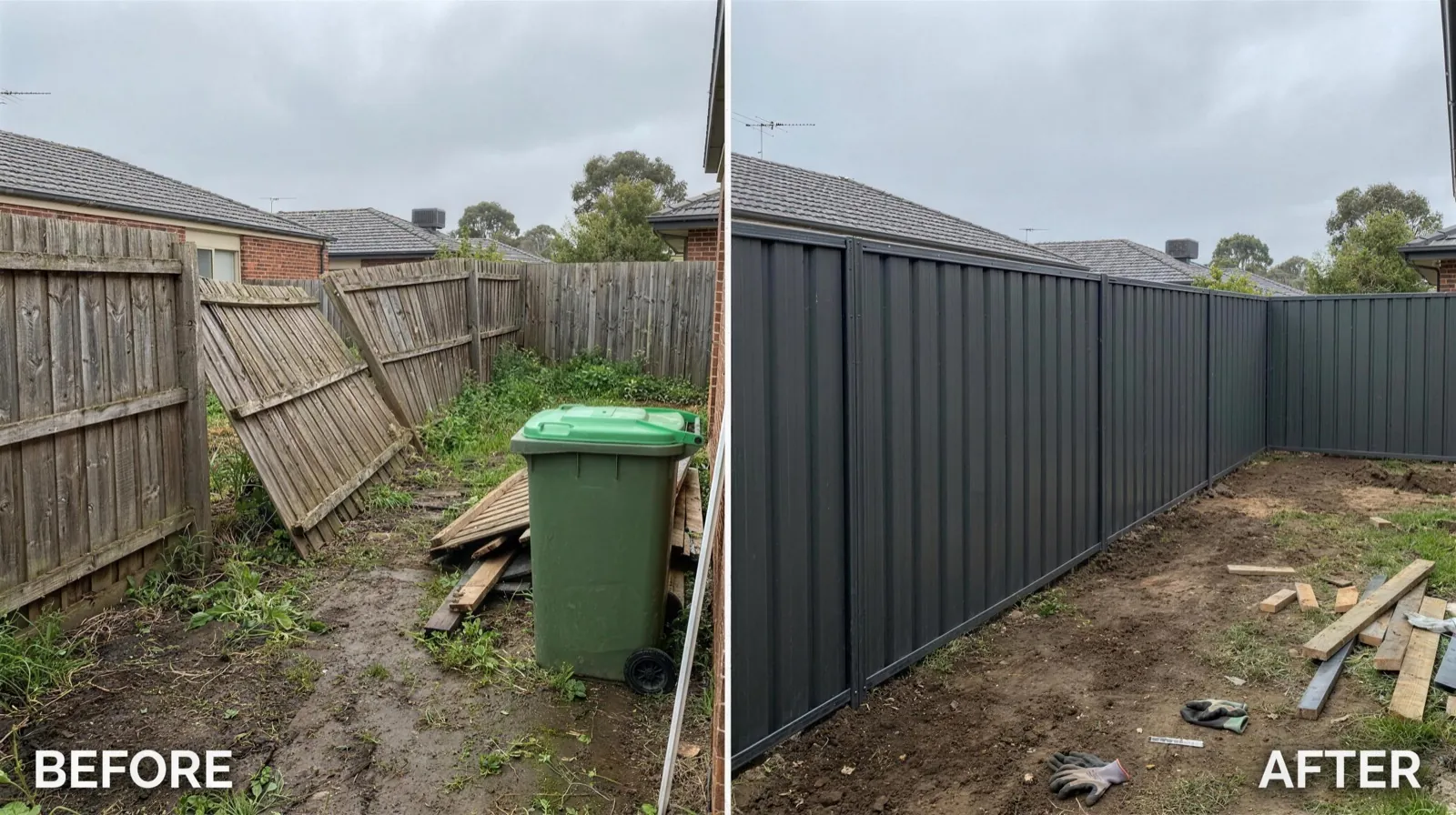
Last month we knocked over a side-boundary Colorbond fence replacement in Craigieburn that's worth talking through, because it's a job we see again and again across Melbourne's northern growth corridor. Old timber paling — sagging, falling, missing palings — swapped out for a clean horizontal Colorbond run. Two days on site, fixed-price quote, neighbour-friendly finish on both sides.
If you've got a tired paling fence at home and you're weighing up whether to patch it or replace, this walkthrough should give you a realistic picture of how a Colorbond replacement actually goes: what we do, why we make the calls we make, and what the cost actually breaks down to.
What we found on site
The Craigieburn job was a 24-metre side boundary on a standard 600m² block — established estate, level grass, average soil. The existing fence was about 18 years old: treated pine paling with capped tops, the kind that was the default in every Hume Council estate built in the early 2000s. The posts had rotted at the ground line, the rails were warped, and three panels had collapsed inward after the May storms.
The homeowner had been quoted to "repair" the fence by another contractor — replace four panels and brace two posts — for around $1,400. Our advice was different: at 18 years old, with structural failure already underway, repairing four panels would just delay the inevitable by another 18 months. They'd be paying twice.
If more than 25% of the panels or posts are structurally compromised, replacement is almost always cheaper over a 5-year window. Patch jobs on old timber pulls labour twice and you still end up with a 20-year-old fence.
Why we recommended horizontal Colorbond
The homeowner wanted something low-maintenance, modern, and storm-proof. Three reasons we landed on horizontal Colorbond rather than vertical:
- Visual fit with newer estates. Horizontal panels read as more contemporary and complement the rendered-brick homes in the area. Vertical is the safe traditional pick, but horizontal is what's trending in 2026 for new builds and refreshes.
- Wind load. Horizontal Colorbond uses heavier-gauge profiles between the posts, which handles the open-paddock westerlies the northern corridor cops without flexing.
- Genuine BlueScope steel. We only use BlueScope-branded Colorbond — not the cheaper import-coated steel that's been creeping into the market. The colour holds and the warranty actually means something.
Colour was Monument — a deep charcoal grey that hides scuffs and pairs well with both light-brick and dark-brick homes. Surfmist and Woodland Grey were the other two options on the table.
Materials we used
For the curious — here's the full materials list for the 24-metre run:
- 13 × Colorbond steel posts (75×50 RHS, Monument)
- 12 × horizontal Colorbond infill panels (1800mm height)
- 24 × heavy-duty rail brackets (galvanised, powder-coated to match)
- 26 bags of rapid-set concrete (20kg) for footings
- Galvanised tek screws + colour-matched caps
Total material cost: around $2,100 wholesale. The remaining quote covered labour, demolition and removal of the old fence.
The install — day by day
Day 1: Demolition and post setting
We started at 7am. Old fence came down in about three hours — paling removed, rails cut out, posts dug or jacked out depending on how rotten the bases were. Old materials loaded into the trailer for disposal. By midday we'd marked out and dug the 13 new post holes (450mm deep, 300mm diameter), set the corner posts and the run posts, and got concrete in. Posts left to cure overnight.
Day 2: Panels and clean-up
Posts were ready by 8am. We ran the bottom rail first, then slotted the horizontal panels in working up from the ground, and capped with the top rail. The panels click into the post channels with no exposed fixings on the front — that's the "neighbour-friendly" finish: both sides look identical, no ugly screws showing on one face. Final clean-up, scrap timber into the trailer, lawn raked. Off site by 3pm.
What the job actually cost
For 24 metres of 1.8m horizontal Colorbond in Monument, including full demolition and removal of the old fence: $4,320. That's $180/metre installed, which is the going rate for this spec in 2026.
Cost factors that pushed it slightly above the floor of our standard pricing:
- Old fence demolition added about $400 of labour
- 13 posts on a 24m run = one extra post for stability on the open western boundary
- Soil was reactive clay — needed deeper footings than the standard 400mm
What the homeowner said
"Quoted Tuesday, installed Friday. The new Colorbond looks fantastic and the crew left the yard cleaner than they found it. Couldn't fault them."
That review is now on our homepage alongside a couple of others. We don't pay for reviews, we don't fish for them — we just ask politely after every job and let the work speak for itself.
If you're considering Colorbond in Craigieburn
The Craigieburn rule of thumb: if your existing fence is more than 15 years old and you're seeing any of rust at post bases, sagging panels, multiple loose palings, or storm damage — get a replacement quote rather than a repair quote. The numbers almost always favour replacement at that age. We do free on-site measures across Craigieburn and the surrounding northern suburbs, usually within 48 hours of your enquiry, and the written quote comes back as a fixed price — not an "approximate".
For pricing, service details and FAQs specific to the area, see our Craigieburn fencing page.