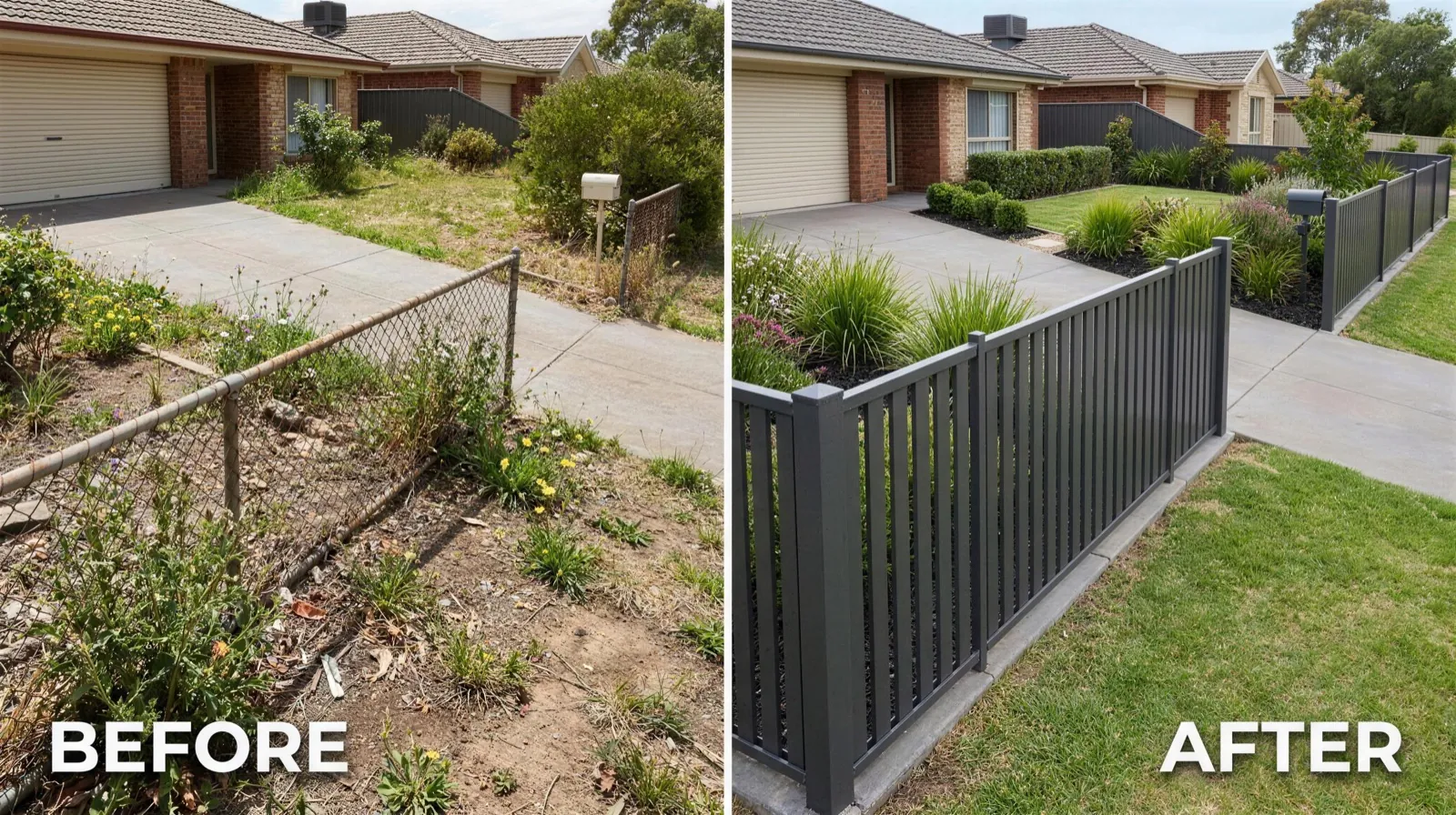
Mickleham is a strange suburb when it comes to fencing. On one side of the Hume Highway you've got brand-new Cloverton and Merrifield estates where every fence is grey Colorbond. On the other, you've got 1880s farmhouses, weatherboard cottages, and post-war brick veneers where a sleek metal fence would look completely wrong. That's the heritage-style problem — and it's worth knowing your options before you commit.
This guide covers what we recommend for period-appropriate timber paling fences in Mickleham and the older pockets of the surrounding suburbs. It won't make you a fencer, but it'll let you have an informed conversation with whoever quotes the job.
What "heritage style" actually means in fencing
It's a vague term and tradies use it inconsistently. For our purposes, "heritage timber paling" means a fence with these characteristics:
- Visible vertical palings — typically 100mm or 125mm wide, run vertically from the bottom rail to a capping board at the top
- Exposed posts — hardwood posts (usually merbau, ironbark or cypress) that stand proud of the paling line every 2.4m, often with a turned, chamfered or pyramid top
- Capping board — a horizontal timber plank that runs along the top, protecting the end-grain of the palings from rain
- Bottom rail near ground level — sometimes with a concrete plinth underneath for added rot protection
That's the look you see on Victorian and Edwardian cottages — and it's still the right call for any home built before about 1960 in Mickleham, Beveridge, or the older parts of Kalkallo.
The three timber options we use
1. Treated pine (the workhorse)
Treated pine is by far the most common timber paling material in Australia. It's affordable, takes stain and paint well, and lasts 20-25 years if installed properly with a bottom rail clear of soil contact. We use H3-rated treated pine for above-ground components and H4-rated for any timber that contacts soil (mainly posts). That's not a corner you want to cut — H2-treated pine in a fence post will rot in five years.
Best for: most heritage and post-war homes where the fence will be stained or painted in a heritage colour (mission brown, charcoal, sage green).
2. Cypress (the local favourite)
Cypress is naturally insect and rot resistant, with a light yellow-cream colour that ages to a soft silver-grey if left unfinished. It's a touch more expensive than treated pine but it lasts longer and looks more authentic on a true heritage cottage. Cypress posts paired with treated pine paling is a common cost-saving combo we suggest.
Best for: heritage cottages where the owner wants the timber to weather naturally without staining.
3. Merbau (the premium feature)
Merbau is a tropical hardwood with a deep red-brown grain. Heavy, durable, and gorgeous when oiled — but expensive. We'd typically only use merbau for feature components: posts with chamfered tops, the capping board, or a gate. A full merbau paling fence is overkill for most homes and pushes you well above $300/metre.
Best for: feature fences where the timber is the design statement (front yard, entry gate, low-pool fencing).
Capping and finish details that matter
The difference between a $100/metre paling fence and a $200/metre heritage paling fence is in the details. Here's where it matters:
Capped vs uncapped tops
An uncapped paling fence — where you can see the end-grain of each paling at the top — will rot from the top down. Water sits in the grain and the paling splits within five years. A horizontal capping board on top fixes this completely. It's an extra $15-25/metre but it doubles the life of the fence. Always cap.
Exposed posts vs hidden posts
On a "lap and cap" style fence, the posts hide behind the palings — one side sees timber, the other side sees posts. On an "exposed post" heritage fence, the posts step forward of the paling line on both sides and you can see them as architectural features. Exposed posts are more expensive (you need finished posts on both sides) but they're what makes the fence look heritage rather than utility.
Concrete plinths
If your block is on reactive clay (most of Mickleham), water sits at the ground line and rots the bottom rail. A 100mm concrete plinth between the soil and the bottom rail eliminates this. Adds about $35/metre to the job and adds 10 years to the fence life. Worth it.
Standard treated pine, capped, exposed posts, 1.8m high: $130–$165/m. Add merbau posts: +$30/m. Add concrete plinth: +$35/m. Add stain & seal: +$25/m. So a premium heritage spec runs $220–$260/m installed.
Heritage overlays — do you need a permit?
The City of Hume has heritage overlays on a small number of properties in Mickleham and Beveridge — mostly the 1880s farmhouses and a handful of old township buildings. If your property has a heritage overlay listed in the Hume Planning Scheme, you may need a permit before replacing a front fence. Side and rear boundary fences are usually exempt.
For 95% of Mickleham homeowners this won't apply. But it's worth a 30-second check on the Victorian Planning Portal before you commit — typing your address tells you immediately if any overlay applies.
Stain or leave it raw?
Three options on a new timber paling fence:
- Leave it raw. Treated pine weathers to silver-grey in 12-18 months. No maintenance required. Looks intentionally rustic.
- Clear oil seal. Lets the natural grain show, protects against water, needs reapplying every 3-4 years. Best for cypress and merbau.
- Stain in a heritage colour. Charcoal, mission brown, sage green, deep ochre — these are the period-appropriate colours. Stained fences look striking but the stain needs touching up every 5-7 years to stay sharp.
Our recommendation for most heritage Mickleham homes: raw or clear-oiled, exposed merbau posts, capped tops. Looks period-appropriate, ages gracefully, low maintenance.
How long will it last?
A properly installed, capped, plinth-protected treated pine paling fence in Mickleham should give you 22-28 years before any major work is needed. Cypress will push that to 30+. Merbau components last effectively forever. The killers are: ground contact, no capping, poor post depth, and reactive soil with no plinth. Address those four things and the fence outlives most kitchens.